
About Electro Homeopathy
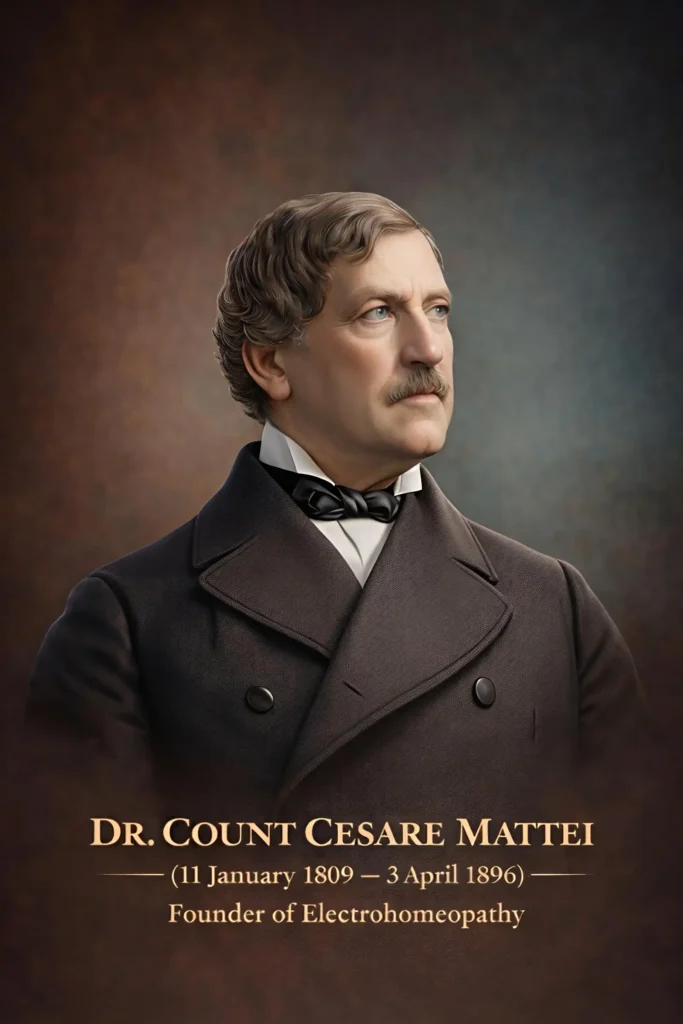
Founder: Count Cesare Mattei
Electro-Homoeopathy was founded in the 19th century by Count Cesare Mattei (1809–1896), an Italian nobleman and researcher. Mattei developed this system after years of experimentation with plant-based substances, with the objective of creating a natural therapeutic approach that worked in harmony with the body’s internal systems. His work gained attention across Europe during his lifetime, leading to the establishment of dedicated treatment centers and the publication of his formulations.
Mattei’s approach emphasized balance within the body rather than disease-centered intervention, which distinguished Electro-Homoeopathy from conventional medical practices of that era.
During his lifetime, Mattei’s work attracted attention across Europe. His methods and formulations were discussed widely, leading to the establishment of treatment centres and the circulation of his ideas through publications and correspondence. His emphasis on internal balance and natural preparations distinguished Electro-Homoeopathy from the conventional medical practices of that period.
Historical Background
Electro-Homoeopathy emerged in Italy in the mid-1800s, during a period when interest in natural and alternative healing systems was growing across Europe. The system spread to countries such as Germany, France, England, and later to parts of Asia, including India.
In India, Electro-Homoeopathy was introduced during the late colonial period and gradually developed a practitioner base. Over time, it came to be regarded as an alternative therapy system rather than a form of modern medicine. Its historical continuity has been maintained through independent institutions and foundations dedicated to preserving its original principles and methods.
Spagyric Principles
A core foundation of Electro-Homoeopathy lies in spagyric principles, a traditional method of herbal preparation derived from classical European alchemical practices. Spagyric processing involves the careful separation, purification, and recombination of plant constituents to retain their natural properties.
Within Electro-Homoeopathy, these principles are applied to prepare plant-based formulations aimed at supporting physiological balance. The emphasis is on natural extraction methods and structured combinations of botanical ingredients, rather than synthetic or chemical interventions.
Difference from Homeopathy
Although the names sound similar, Electro-Homoeopathy and Homeopathy are distinct systems.
Homeopathy is based on the principle of “like cures like” and typically involves highly diluted substances. Electro-Homoeopathy, by contrast, relies on herbal formulations prepared through spagyric methods and does not follow the dilution theory central to Homeopathy.
Additionally, Electro-Homoeopathy focuses on systemic balance and functional support rather than symptom similarity. These foundational differences place Electro-Homoeopathy in a separate category among alternative therapy systems.
Global Practice
Historically, Electro-Homoeopathy has been practised in several countries, particularly in parts of Europe and South Asia. While it is not regulated as a mainstream medical system in most nations, it continues to be followed as an alternative or complementary therapy by practitioners and institutions dedicated to traditional plant-based approaches.
Its global presence today is primarily maintained through educational organizations, practitioner networks, and independent foundations that uphold its historical methods.
- Notices issued by District and Taluk Health Officers solely on the ground of practising Electro-Homoeopathy were quashed
- Authorities were directed to refrain from interference or coercive action, so long as the practice remains lawful
The Court clarified that any assumption that Electro-Homoeopathy practice is prohibited is unfounded, and that lawful practice is permissible within defined limits.
Legal Recognition in India (2025)
As of 2025, Electro-Homoeopathy in India is legally acknowledged as an alternative therapy system. Judicial clarification, including a ruling by the High Court of Karnataka, has affirmed that individuals may practise Electro-Homoeopathy within the bounds of law, provided there is no misrepresentation as modern medical practice.
The practice is permitted with clear limitations: practitioners must not claim medical doctor status, diagnose diseases, prescribe allopathic medicines, or issue government-recognised medical degrees. When practised responsibly and transparently, Electro-Homoeopathy remains lawful under Indian legal frameworks.
Clear Legal Limitations
While practice is permitted, the legal boundaries are explicit:
- Practitioners must not claim medical doctor status
- They must not diagnose diseases in the statutory medical sense
- They must not prescribe allopathic medicines
- They must not award or claim government-recognised medical degrees or diplomas
Electro-Homoeopathy remains lawful in India only when practised responsibly, transparently, and without misrepresentation.
Spagyric Principles
A core foundation of Electro-Homoeopathy lies in spagyric principles, a traditional method of herbal preparation derived from classical European alchemical practices. Spagyric processing involves the separation, purification, and recombination of plant constituents with the aim of retaining their natural characteristics.
Within Electro-Homoeopathy, these principles are applied to the preparation of plant-based formulations intended to support physiological balance. The focus remains on natural extraction and structured combinations of botanical ingredients, rather than synthetic or chemical interventions.
These methods represent a historical approach to herbal preparation and are not equivalent to modern pharmaceutical manufacturing.
Legal Position in India – Judicial Clarification (2025)
The legal position of Electro-Homoeopathy in India has been clearly clarified through judicial pronouncements.
In Writ Petition No. 107627 of 2024, decided on 06 February 2025 by the Hon’ble High Court of Karnataka, Dharwad Bench, the Court examined whether Electro-Homoeopathy practice is regulated under the Karnataka Private Medical Establishments (KPME) Act, 2007 and whether coercive action could be taken against practitioners.
Relying on:
- Government of India Order dated 25-11-2003
- Government of India clarification dated 05-05-2010
- Judgment of the Hon’ble Supreme Court of India in Criminal Appeal No. 4642 of 2018
the High Court held that:
- Electro-Homoeopathy is not regulated under the KPME Act
- No institution can confer degrees or diplomas in Electro-Homoeopathy without statutory authority
- Individuals are permitted to practise Electro-Homoeopathy as an alternative therapy, provided they act within the bounds of law
- Notices issued by District and Taluk Health Officers solely on the ground of practising Electro-Homoeopathy were quashed
- Authorities were directed to refrain from interference or coercive action, so long as the practice remains lawful
The Court clarified that any assumption that Electro-Homoeopathy practice is prohibited is unfounded, and that lawful practice is permissible within defined limits.
Conclusion
Electro-Homoeopathy is a historically established alternative therapy system rooted in nineteenth-century Europe and founded on plant-based formulations and spagyric principles. Its presence in India has been sustained through independent professional and organisational efforts rather than statutory medical recognition.
Judicial clarification by the Hon’ble High Court of Karnataka, relying on Supreme Court precedent and Government of India orders, has clearly affirmed that practice of Electro-Homoeopathy as an alternative therapy is permissible under law, subject to defined limitations.
This clarity places responsibility on practitioners and professional organisations to ensure ethical conduct, honest representation, and strict compliance with legal boundaries, thereby safeguarding public interest and professional integrity.
Disclamer
Electro-Homoeopathy is practised as an alternative therapy.
Karnataka Electro Homoeopathy Foundation (Reg.) is a professional membership organisation and does not award medical degrees or licences.