
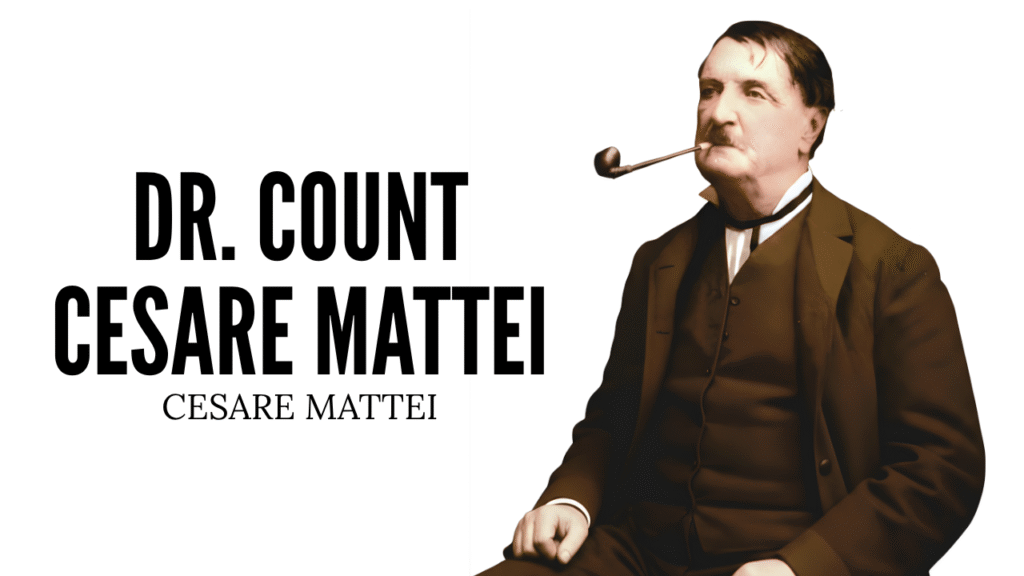
Count Cesare Mattei (1809–1896) was an Italian nobleman, philosopher, and visionary whose unrelenting curiosity led him to challenge the medical orthodoxies of his time. Renowned for his pioneering work in natural healing, Mattei devoted his life to understanding the intersection of science, nature, and human vitality, ultimately founding the innovative system of Electro-Homeopathy—a therapeutic approach that sought to harness the restorative powers of plants and subtle energetic forces within the human body.
Born into an affluent and influential family near Bologna, Italy, Mattei received a classical education and was deeply immersed in the intellectual climate of 19th-century Europe. Although he began his career in politics—serving as a deputy in the Papal States—he withdrew from public life following personal tragedies, including the death of his mother. This profound loss ignited his lifelong quest to discover more humane and effective methods of healing, free from the harsh treatments and invasive procedures that dominated contemporary medicine.
In 1865, after years of private study in chemistry, physiology, and botany, Mattei announced his new system: Electro-Homeopathy. This approach combined the principles of homeopathy with what he described as “electric fluids”—vital energetic forces present in both plants and the human body. Mattei believed that illness resulted from imbalances or obstructions in these natural energies and that carefully prepared botanical remedies could help restore harmony without causing harm. His “electricities,” extracted through complex processes from medicinal herbs, were designed to target specific organs and systems, promoting healing by rebalancing the body’s internal energies.
Mattei’s methods were both radical and appealing. At a time when mainstream medicine often relied on bloodletting, mercury treatments, and other harsh interventions, his gentle, plant-based remedies offered a compassionate alternative. Patients reported remarkable recoveries, and soon Electro-Homeopathy gained a devoted following across Europe, India, and beyond. Physicians, scholars, and even members of royalty sought out Mattei’s guidance and remedies, intrigued by his claims of success in treating chronic and “incurable” diseases.
His residence, the magnificent Rocchetta Mattei, built on the ruins of a medieval fortress in the hills of Emilia-Romagna, became both a personal sanctuary and a center of medical experimentation. Architecturally eclectic—featuring Moorish, Gothic, and Renaissance influences—the castle embodied Mattei’s philosophy of blending science, art, and spirituality. It housed laboratories, libraries, and reception halls where the Count welcomed guests, students, and dignitaries eager to learn about his discoveries. The Rocchetta itself became a living symbol of his belief in synthesis—between tradition and modernity, body and spirit, nature and technology.
Though Electro-Homeopathy faced criticism and skepticism from the established medical community, it nonetheless persisted as a parallel healing tradition. After Mattei’s death in 1896, his followers continued to promote and refine his techniques, keeping his legacy alive across Europe and Asia. In countries such as India and Germany, practitioners still employ Electro-Homeopathic remedies today, guided by Mattei’s principles of balance, natural harmony, and gentle restoration.
More than a century later, Count Cesare Mattei remains a fascinating figure—part scientist, part mystic, and wholly committed to the belief that true healing must engage both nature and the human spirit. His life and work remind us that progress in medicine often begins not with conformity, but with the courage to imagine alternatives. Through his vision, the Rocchetta Mattei still stands as a testament to the enduring quest for holistic wellness and the timeless faith in the healing power of nature.